
About six months ago, we announced the formation of the first dedicated AI team within the WordPress open-source project. I have the privilege of co-leading that effort alongside my role directing AI initiatives at Automattic.
The Core AI team exists to build foundational capabilities into WordPress itself – not flashy features, but the infrastructure that makes AI-powered features possible across the entire ecosystem. Hundreds of millions of web properties.
When we launched, we published a strategy document called “AI Building Blocks.” It outlined four foundational pieces we believed WordPress needed to be ready for an AI-native future. At the time, I wasn’t sure (nor did I expect that) we’d ship all four by WordPress 6.9.
We did.
Six Months That Felt Like Six Years
At State of the Word 2025, I made a comment: one month in AI is like a year in normal development time. I really wasn’t joking. The landscape shifts so fast that roadmaps become artifacts almost as soon as you publish them. DeepSeek dropped an open-weight GPT-5 level model days before the event. Browser-native models are shipping in Chrome and Edge. The agentic browser category barely existed when we started this work.
And yet, the strategy held. The four building blocks we outlined in June are shipping in December – not because we predicted everything correctly, but because we built at the right layer of abstraction (and because of the absurd energy, effort and enthusiasm of dozens of talented contributors).
The Building Blocks
WordPress 6.9 ships with four foundational AI components. I’ll go through them briefly, but the real story isn’t the individual pieces – it’s how they compose.
The Abilities API creates a unified registry of what can be done on a WordPress site. Here’s an action, here’s what it needs, here’s what it returns. Hand a collection of abilities to an LLM and tell it to pick the right one for a task – that’s an agent. We’ve made it trivially easy to build agents into and around WordPress.
This one is personal. Greg Hunt and I desperately needed something like this years ago when we were building agents at WPAI. We designed early versions of this system together. Seeing it ship in core feels like closing a loop that’s been open for a long time. (History lesson here if you’re curious.)
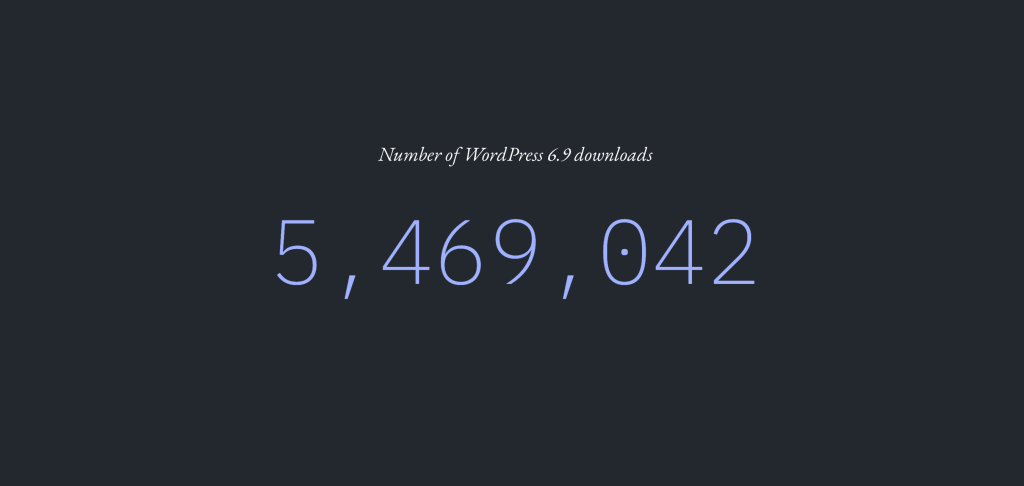
If you follow me on X, you’ll see that I’ve been tweeting about this a lot. I’m really excited for this to exist. Not only is it useful on so many levels, it’s deeply fulfilling on a personal level to see an API I helped conceive and design make it to such a dramatically important piece of software. As I publish this post one day later, we’re already up to 5.5 Million downloads of WordPress 6.9.
The WP AI Client provides a provider-agnostic interface to any LLM. OpenAI, Anthropic, Google, local models – the site owner chooses, the plugin developer doesn’t have to care. Felix Arntz and Jason Adams architected most of this, and it’s elegant. I know, because I’ve been building a lot of AI Experiments with this, for both the plugin mentioned below, but also features for this personal blog (click the star in the header ). Version 0.2.0 dropped the day before State of the Word with direct abilities support.
The MCP Adapter exposes abilities to external AI services via Model Context Protocol. The adapter pattern is intentional – if MCP gets replaced by something else (and in this industry, everything gets replaced), we swap the exposure layer, not the underlying logic.
We’re already seeing it in production on WordPress.com and WooCommerce.
The AI Experiments Plugin ties it all together. Reference implementation for developers, real features for users. It’s on the plugin repository now.
What Wasn’t Mentioned On Stage
Here’s what I’ve been thinking about since the event.
The Abilities API gets compared to WordPress’s hook and filter system – Matt made this connection during his presentation, and it’s apt. Hooks created the conditions for WooCommerce and Yoast and Elementor to exist. They didn’t predict those outcomes; they made them possible.
But there’s a dimension to abilities that goes beyond hooks: they’re designed to be understood by non-human actors. A hook is a contract between developers. An ability is a contract between anything that can reason about actions – including systems that didn’t exist when the ability was written.
This is a weird thing to build for. You’re essentially writing documentation for future AI systems that will interpret your code. The schema matters. The descriptions matter. The constraints matter. It’s a different kind of engineering than most WordPress developers are used to.
I think this is where the ecosystem is going to need to level up. Not on AI features per se, but on legibility – making plugins and themes comprehensible to AI systems at a structural level.
The Consumption Model is Already Shifting
Something that was mentioned briefly in the panel: AI traffic has already surpassed human traffic on many sites. We absolutely see this at Automattic. It’s not hypothetical.
Most of this is crawling and indexing right now – models being trained, RAG systems being populated, search indexes being built. But the next wave is agentic. Users telling Claude or Google’s AI Mode or ChatGPT to “go update my WordPress site” or “find me a plugin that does X and install it.” Browser-based AI that can navigate wp-admin on your behalf.
WordPress needs to be ready for this. Not in a defensive way – not trying to block or rate-limit AI systems – but in a way that makes the platform genuinely useful to them. If an AI agent can understand your site’s capabilities through the Abilities API, it can help your users more effectively. That’s good for everyone.
The alternative is AI systems screen-scraping wp-admin and clicking buttons blindly. That’s coming regardless. We might as well make it work well.
Content Is King, Again
There’s a line I keep coming back to: AI needs content to run well. We don’t (yet) have OpenAI robots flying around reporting the news. Humans report the news. Humans write the posts. Humans create the things that make AI useful.
This is the inversion that a lot of people miss. AI doesn’t replace the open web – it makes the open web more valuable, if we push in that direction. The people and platforms that create, curate, and publish will matter more in an AI-mediated internet, not less.
When I publish something on my blog – like the story of how the Abilities API came together – I want it to show up when someone asks ChatGPT about it. I want my thinking to be part of the training data, part of the retrieval corpus, part of the conversation. The act of writing and publishing is more important now than it’s been in years.
Note: An interesting alternative is the opposite – maybe you don’t want your content to be a part of this – and that’s also something WordPress can allow, or help enforce. I’ve done some plugin explorations into RSL and sit as a technical advisor to the project.
WordPress, as the largest publishing platform on the planet, is positioned to be the foundation of that future. But only if we build for it intentionally.
Collaborative Editing Meets AI Agents
One overlap I’m genuinely excited about: Phase 3 collaborative editing and AI assistance.
When multiplayer editing was designed, it imagined other people sitting next to you in a document. Cursors moving, suggestions appearing, comments attached to blocks. What we didn’t anticipate was that some of those collaborators might not be human.
The architecture supports both. Block notes, suggestions, real-time collaboration – these features work whether the entity on the other end is a colleague or an AI agent reviewing your draft for accessibility issues. Same infrastructure. Same interaction model.
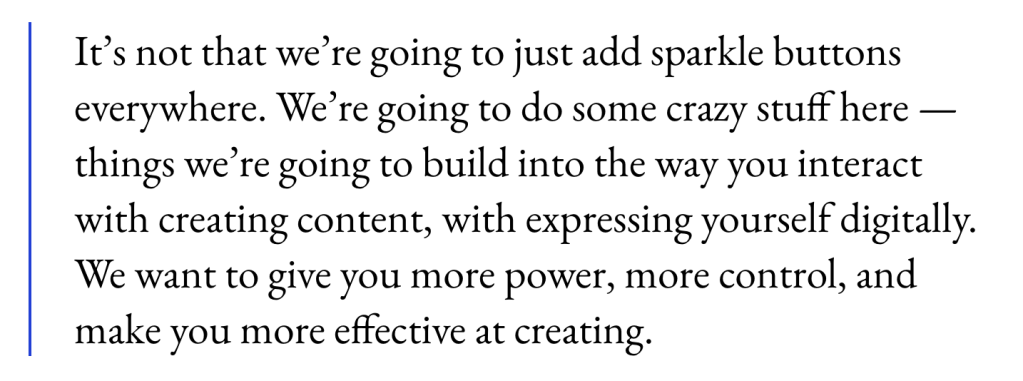
This is what I mean by empowerment over replacement. We’re not adding sparkle buttons that generate content for you (though the experiments plugin includes some of that). We’re building tools that make you more effective at creating – tools that work with you, not instead of you.
What’s Coming in 7.0 (AI-wise)
The client-side Abilities API ships in 7.0, completing coverage across the entire WordPress stack. That unlocks better interaction with browser-based AI tools and agentic interfaces.
We’re also introducing the Workflows API – a sister to Abilities that lets you string actions together. An ability is a single unit of work. A workflow is a sequence: when an order comes in, send an email, update inventory, notify the team. Triggers, conditions, chains of execution. Exposed through MCP. If you love n8n, think of this as bringing some of that into WordPress core.
The WP AI Client moves into core too. Every plugin developer building AI features gets a unified foundation. Hosts can bundle AI credits. Plugins can fall back to whatever provider is available. AI becomes a commodity layer.
Two Asks
During STOW, I had 2 asks.
If you’re a plugin developer: look at the Abilities API. Use it to build AI features, yes, but also use it to expose your existing functionality to AI assistants connecting through MCP. The more abilities exist in the ecosystem, the more capable the agents become.
If you’re a host: track the WP AI Client. We can see a future where every major host bundles AI credits into their plans. When that happens, any plugin using the client has AI capabilities out of the box. That’s how you democratize access – not by picking a winner, but by making the infrastructure universal.
And a third, for fun – if you’re a user … get excited! Use this stuff! Let us know what works, what doesn’t and what you want 🙂
The Longer View
Two years ago, if you’d asked me whether WordPress would have first-class tooling for building AI agents, I’d have been skeptical. It’s a blogging platform. It’s a CMS.
But that’s exactly why it matters. WordPress has been around for over twenty years. It powers 43% of the web. It’s not going anywhere. And if we build foundational systems that adapt to whatever the AI landscape becomes, WordPress will be the center of the open web for the next twenty years too.
The primitives we now have fit together like legos – and now WordPress really is a great place to build AI.

The open web is going to change. The way people consume content, the way they interact with services, the way they build and create – much of it will be mediated by LLMs and AI. The question is whether that future is open or closed. Controlled by a handful of platforms or distributed across millions of independent sites.
I know which future I’m building for.
Watch the full event here, recorded December 2nd 2025 from the heart of San Francisco:
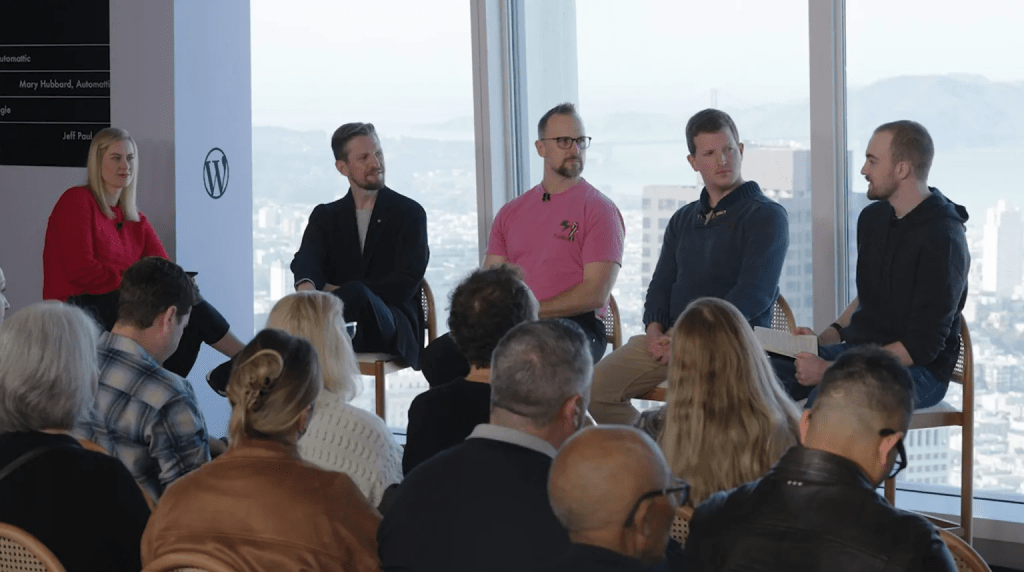
Here are the direct quotes from my points on the State Of The Word AI panel this year.
On what’s shipped and the foundational pieces of AI for WordPress:
“Well, first off, hello everybody. Great to see y’all. There’s been a lot going on in AI and WordPress for a while now. So quick history lesson. The Core AI group was created and announced about six months ago. When we were created about six months ago, we published a strategy called AI building blocks. And that represented the work that we wanted to do moving into the future. But that strategy was something that we put together informed by years of thought and effort into AI. Matt mentioned LearnAI deeply in 2022. We then moved on in 2023 to become begin officially messaging around AI through the project. And we also tracked where the industry was going and what was happening in terms of AI models, what their capabilities were, what they were good at, what they weren’t good at. So when we were announced six months ago All of that thought and effort went into that announcement and went into the work around creating this strategy, this roadmap of building blocks. To directly answer your question, the building blocks, we have four. And when we announced six months ago, I did not expect to say that all four are delivered for 6.9, but they are. They are. Thank you.”
On the four building blocks:
“Yes. Yes, and we should absolutely direct those applauds to the contributors and the team that actually built all of this. So to go through these four, we have the abilities API was mentioned a few times in the presentation, and that is this unified registry of logic that allows both humans and AI systems to understand what can be done on WordPress. And it gives basically a list of here’s what you can do. And to do it, here’s the information that we need, and here’s what the expected outcome of running a single ability is. And that’s really exciting in isolation. You can use it to go and create a whole bunch of different things like commands for the command palette, for REST API endpoints, CLI, things like that. But for WordPress, you can basically box up a bunch of these abilities. Give it to an LLM and say, LLM, go run these things. Go, I want to do something. Go read through this list and choose the right ability for the job. And that in isolation is an agent. So we’ve made it very easy to build agents into WordPress and around WordPress. The second big package is the WP AI client or WP client AI, AI client. I always mix these up. We have tongue twister names. This is something that allows us to immediately and directly interface with LLMs from WordPress. And Felix actually architected most of it, so I’ll let him speak more about it. But Something I’m very excited about is that it just released a version 0.2.0 yesterday, and that includes direct support for abilities. So you can now provide abilities to an LLM from OpenAI or Anthropic or Google or whoever you want and say, go run these abilities and create those agents that I just mentioned. We also have the MCP adapter. Matt mentioned during his presentation, version 0.3.0. You can use that to take all your abilities, connect it off to a third-party service like Claude. OpenAI and have a AI pilot your WordPress website through this abilities adapted out through this protocol. The adapter pattern is really exciting to me because it’s very persistent. It means that we can expose things out to MCP, but say MCP changes and we really don’t like it anymore, we can go and adapt out to another protocol very easily. Then finally, all of this surfaces in the AI experiments plugin, which is a representation for developers on how you can use these blocks. But it’s also something for end users to actually use AI features in WordPress powered by the blocks that we’ve created. And it is now on the WordPress plugins repository. And I’ll let Jeff speak more about that, but that is a big, big milestone. So that’s what is in 6.9, and that’s what we said we were going to do, and we didn’t expect to do it all by 6.9, but we did.”
On AI time:
“Like one month in AI is like a year in like normal development time. You say six six months and for AI time that’s like six years. Yes.”
On how WordPress will stay on the forefront of AI:
“That’s a good question. It it really stems back to creating the foundational pieces of WordPress to build AI and then seeing what the ecosystem does. So if you look back to WordPress itself It gave the frameworks to go create plugins and then you ended up with humongous e-commerce solutions and learning management tools and things that I bet you, Matt, did not expect to blossom.”
On what’s coming for 7.0 and the long-term vision:
“I have to open my notebook of seven dot oh.”
“Cool. And Matt, feel free to jump in and interject.”
“And I’ll cover both. Near term. The Abilities API is going to continue to improve. We shipped the server half of it, but we’re shipping this client half of it in 7.0. And that gives you complete coverage of the entire software of WordPress. It allows us to easily in the future interact with AI browsers more effectively. It’s pretty impressive. But we’re also introducing a sister API that sits besides the abilities API, and that’s workflows. And you might have actually seen an Easter egg in the code snippet from Matias that said workflows. Abilities are awesome, they’re individual units of what you can do on a WordPress site, but they can become really powerful when you string them together. And you have more determinism and I know that when an email happens or when a when an order happens in WooCommerce, I’m gonna send an email. These are two abilities, I string them together, and they run on a trigger, or they run when I command palette them. And that API is going to be a very, very powerful and interesting one. It will also be able to be adapted out, exposed through MCP, and really create a foundational piece of WordPress to do automations. and some really interesting stuff with AI. We also have the WP AI client, that exciting thing that Felix mentioned, coming to 7.0 as well. And the plumbing to interact with AI will be a core piece of WordPress, which means that everybody who builds these features, everybody who builds plugins, can build in a unified way. And that allows us to go and easily plug into providers like Google, but also easily have a host or an agency offer a provider of their own. And any plugin that uses this API will immediately have AI.”
On democratizing AI:
“So I don’t want to completely say we’re democratizing AI, but we are democratizing access to AI through this inclusion.”
On Abilities API parallels to WordPress hooks:
“Yeah, and it’s also the big three, also actions in WordPress, you can trigger workflows and abilities through actions as well. So I think there’s a lot of like new and old merging together. It’s really, it’s exciting to me. Final on my list is the, and Jeff mentioned this, but the overlap with collaborative editing. So that’s a very big cornerstone feature of WordPress. 7.0 phase 3. And I think when it was designed, we didn’t necessarily design it with the intention of AI being the way AI is today. But there is a very, very natural and helpful overlap there where collaborative evident Collaborative editing means there are other entities sitting next to you on a page helping you edit and create.”
On the collaborative editing and AI overlap:
“Exactly. So I think that’s a really good also Roundup of this is how WordPress wants to empower people. It’s not we’re gonna just add sparkle buttons everywhere, we’re gonna do crazy stuff here. It’s more that we’re gonna build into the way you interact with creating content with Expressing yourself digitally and give you more power, more control, and be make you more effective at creating. So that overlap with collaborative editing through block notes, through the actual collaboration aspect, suggestions, a lot coming in the future there. I can see really clear coverage there. I can also go long term if we want.”
Long-term vision:
“WordPress has been around for 20 years, and we want it to be around for the next 20 years. And the next 20 years looks like WordPress remaining what it is today, which is the center of the open web. That open web is going to change. It will move and shift and change as AI changes the way people consume content and create online. But I do expect the open web to be something that can be a cornerstone feature. I mentioned before content is king. AI needs content to run well. We don’t have open AI robots flying around reporting the news. We have to report the news. We have to manage the content. We have to create and express ourselves digitally. I was thinking a few days ago, the act of writing and publishing is almost more important now with AI because I want my thoughts. I want who I am and the story of how Abilities API was created, which I published on my blog, I want when people ask that to ChatGPT for it to show up. So Creating these fundamental systems allows us to create a piece of software that does also adapt with the open web and remain that central place that humans express themselves. And that’s what we expect to continue pushing towards with 7.0, but also into the future as well, in introducing these foundational, fundamental pieces to go and build really interesting and expressive expressive Uh solutions for you in a unified way.”
The asks for developers and hosts:
“I have two asks for people, especially developers and hosts. We have introduced these blocks to be used. And the people who operate within WordPress are the plugin developers and they are the hosts. And for the plugin developers, we really ask you to take a look at these abilities and use them to create AI features yourself. but also expose the existing functionality of your tools out to the AI assistants that are coming to WordPress, the ones that can already interact through MCP. Use the blocks. Go and use the WP AI client to go build AI features into your software. And for the developers, really track the WP AI client. Or for the hosts, really track the WP AI client. I can easily see a world where all hosts, and I know that three major hosts already, will provide bundled AI credits into their plans. Which means that you will have AI out of the box for any plugin that uses this API and interacts and says, I will fall back to whatever pro provider is available. And that means AI can become a commodity. And it becomes something that everybody can use, everybody has access to, and it really pushes us back to plugins extending WordPress, working with AI, AI and not being this core primary feature, but just something that supercharges the way we work with WordPress. So those those are the two asks there. The final ask is for everybody to go try the AI experiments plugin. It’s on the WordPress repository as of I think yesterday. Yesterday. So WordPress.org slash plugin slash AI. That’s a representation of features that you can actually use, but also the blocks working together. And that will be a way we deliver really impressive features into the future. You can also contribute to that as well.”
On predictions about WordPress and AI:
“I also I think if you asked us af if you asked me two years ago if WordPress would have first class tooling to build AI and agents, I’d be like, I don’t know It’s a blogging software, right? Like it’s just a blog. We do have that and it sits directly besides content which is king in in AI era. So it’s really fun to see not just these come together but actually build with them and contribute to the AI experiments plugin and just see how easy it is. It’s awesome.”
On the global command palette:
“And the global command pallet that was mentioned here will use abilities.”