
The history of language is a history of cost collapses. Writing was one. The alphabet was another. The printing press was the most disruptive of all, not because it was the most sophisticated, but because it took the cost of producing language and crashed it by an order of magnitude.
Before Gutenberg, a single Bible was a year of a scribe’s labor. A book could cost a year’s wages. In 1450 there were about 30,000 books in all of Europe. Fifty years after the press, ten to twelve million. English male literacy was around 10% in the late 1400s. By the mid-1700s, after centuries of cheap print, it was 60% (literacy important in and of itself, but also a proxy to lifespan, health, et). By 1900, after steam presses ran 12,000+ impressions an hour to Gutenberg’s 240, it was 97%. (related, a 2 good books that touches on similar progress; Boom: Bubbles and the End of Stagnation and Where Is My Flying Car?!).
Each wave, the establishment panicked. Books would corrupt the masses! Pamphlets would destabilize the church. Cheap print would fill libraries with garbage. Each wave, the question shifted. From who has access to who can shape it down.
Words are cheap now. Not only cheap. They’re becoming almost free. A prompt, a few seconds, and the internet has another post. The marginal cost of language has collapsed again, and with it the old assumption that volume signals effort.
By volume, written words are becoming noise. Social already did this to media. The output clogs the human context window before meaning lands. Or worse, fills it with the wrong things.
The great filter is craft, code, art — Effort hasn’t been in the creation of the words for some time now. It has been in choosing which words.
Craft.

In Practical Typography, Matthew Butterick frames the work as utilitarian. Reader attention is finite. Readers are always looking for the exit. Every bit spent on the mechanics of reading is attention that never reaches the meaning. The typographer’s job is subtraction. Compress the friction until only the message is left.
There’s a line in the book he calls his First Law of Typography. He wrote it pre-LLM, and it really reads now like he saw it coming. Readers lean on typography to judge a piece when substance gets harder to judge. As substance becomes cheap and hard to evaluate, presentation and arrangement become the load-bearing signals. Not decoration, but structure.
Code.
I wrote about this for software about a month ago in Code Sculpting. Generate the whole thing, then carve. The output is not what the model produces. The output is what you reveal after hundreds of iterations of removal. Tighten this. Consolidate that. Kill this abstraction. The codebase gets smaller. Somewhere in that shrinking it gets good.
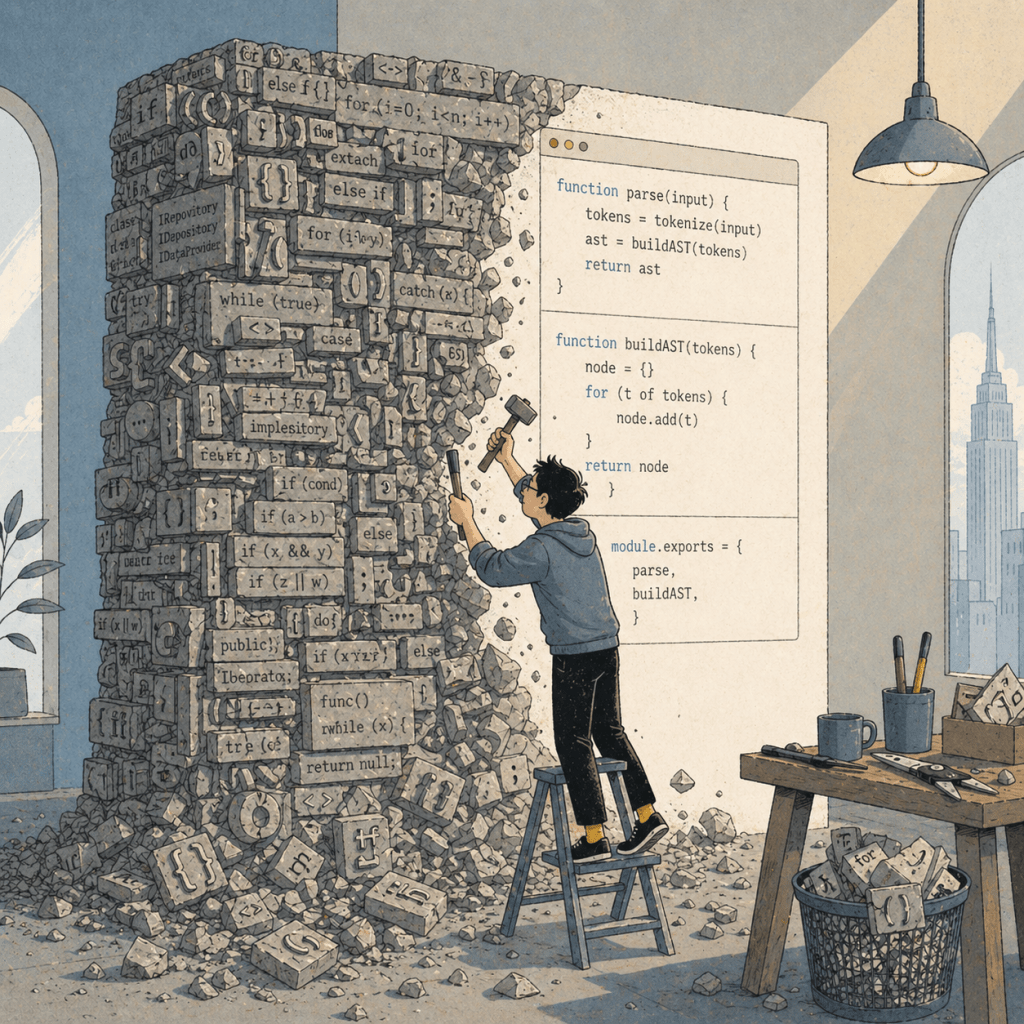
The craft is in the taste to know which refactor matters. Which PR to pluck and merge. When to say no. That doesn’t come from the model. It comes from you.
Art.
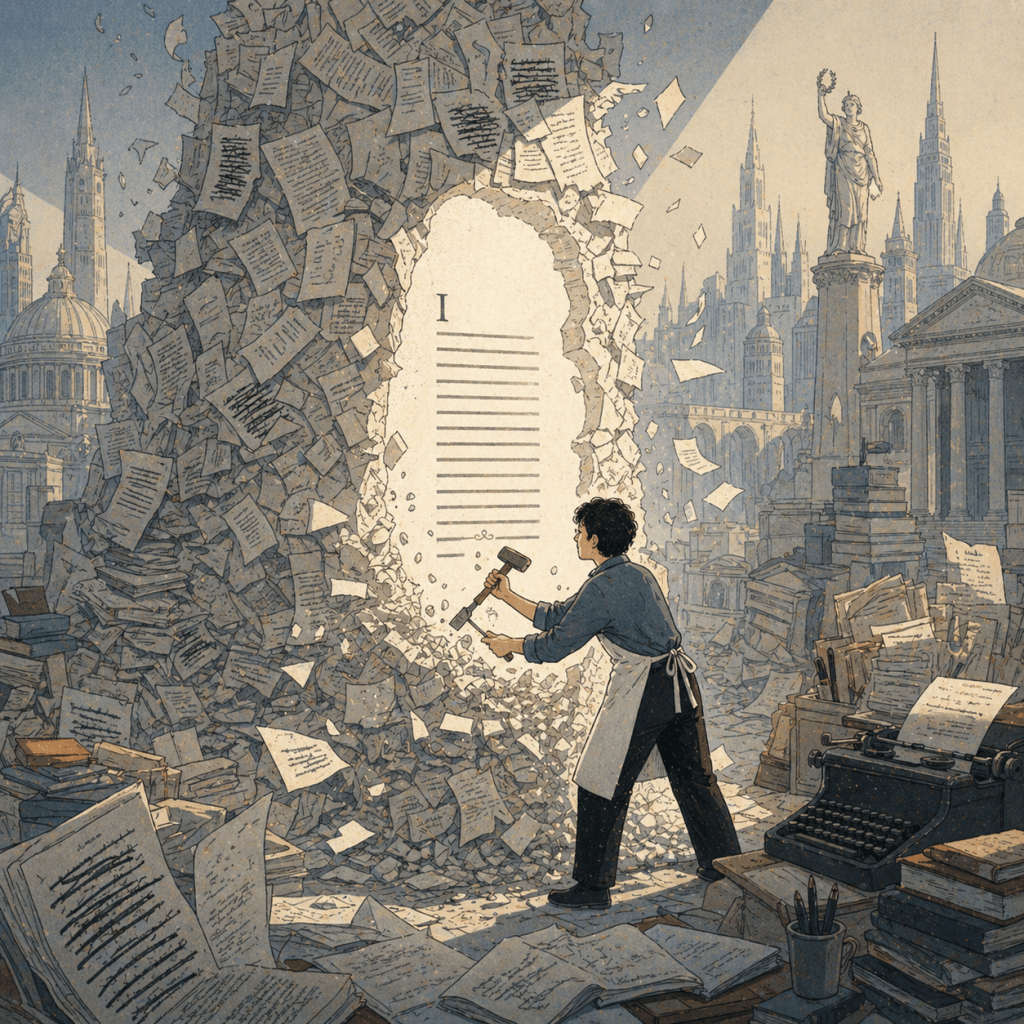
In Dan Simmons’ Hyperion (a great, insane book), there is a planet where a king builds a city for poets. Sad King Billy funds them, houses them, gives them time. One of them, Martin Silenus, spends several lifetimes on the Cantos. Not adding to it, but cutting it down. Poetry is not the accumulation of words. It is what remains after everything unnecessary has been struck away.
That is the pattern underneath all of this. A sculptor does not carve the marble into a shape. They remove the marble that was not the shape. A typographer removes the friction that hides the meaning. A refactorer removes the code that was not the system. A poet removes everything that was not the poem.
Craft, code, art. Three names for the same act.
We now live in Sad King Billy’s city. The models are the patrons. The words are infinite. Anyone can be a poet in the crudest sense. Anyone can produce text (and images, and video, and audio, and digital{xyz}). The question, the only question that separates anything from anything, is who can strike away the parts that were not the poem.
The tools democratized generation. The taste to remove is still, and will always be, yours.